
Z-Theory. Introduction
Z-Theory primarily utilizes categories of continua and fields, unlike earlier proposed theories. Z-Theory utilizes numerous new categories. All of them take the names of some previous categories (close in meaning) with a 'Z' prefix before them to distinguish those categories of categories used in Z-Theory. The name of Z-Theory appears the same way. 'Z' comes from the last name of the father of the theory (Allan Zade).
The most fundamental category is the Z-Continuum itself, which exists everywhere and at all times. That continuum supports propagation of disturbance of any kind. Motion of an object or a celestial body in that continuum appears as a continuous disturbance of the continuum caused by the object. As mentioned earlier on this site, each body produces a disturbance around it. The easiest way to detect disturbances is through the propagation of electrical fields. An object with an equal amount of positive and negative charges produces that disturbance in two ways. As a result, the impact of that disturbance on another object appears as a net force equal to zero. However, each force taken separately does not equal zero.
Another aspect of Z-Continuum is its ever-existent. In other words, categories of the past and the future that appeared in the human mind throughout its history become a physical reality in Z-Theory. The following picture explains those categories graphically.
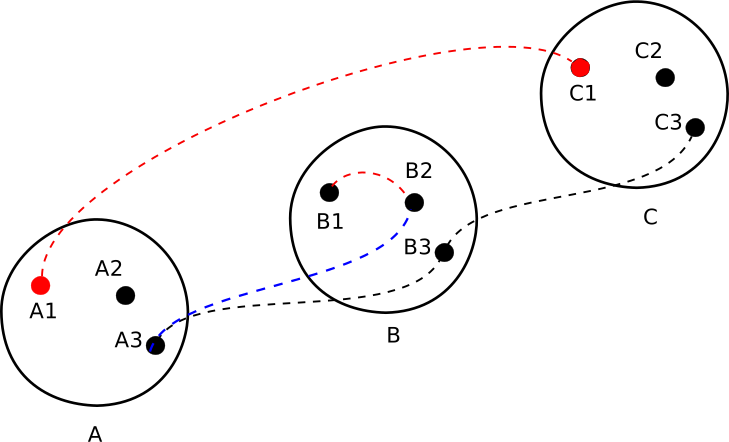
Fig. 1. Motion and Transposition in Z-Continuum
Figure 1 illustrates a celestial body (such as the Earth) that moves through the Z-Continuum. It has three distinguished locations in the continuum (A, D, and C). An observer starts observing that motion at point A and finishes observing it at point C.
The observer determines three points for observations. Those are points 1, 2, and 3. Each point has an exact location on the surface of the celestial body. For example, Parish has some exact location on the Earth's surface (point 1) as well as London (point 2) and Rome (point 3). Each city remains in its original location in relation to other cities, unchanged due to the solid Earth's crust.
Suppose now this. A person (let’s call him Bob) likes to move from Rome to London in his car. In the case of a ground observation, the travel route takes a path between points 3 and 2. However, according to observations from the Z-Continuum, travel involves a trajectory between points A3 and B2 (see Fig. 1). Each step of this motion is accessible for observation by any ground observer because they move with the planet, as well as the moving observer, and both cities.
Moreover, the ground observer comprehends the initial location of the moving observer through his memories, as the car left the city of Rome, and every step of its motion remains only in the memory of the ground observer. In other words, the ground observer thinks this. There is no physical experiment that confirms the car's initial location.
Moreover, the ground observer is aware of this. He uses a clock previously synchronized with Bob’s watch. The watch and the clock move through the Z-Continuum along with the planet. Therefore, the duration of planetary motion exactly equals the duration of motion of the clock and the watch. As a result, both devices count the same duration and show the same indication at the end of travel. Strictly speaking, that phenomenon keeps “a correct indication” of all Earth-bound clocks and watches.
For example, an atomic clock located in Rome keeps trajectory A3-B3 during Bob’s travel. An atomic clock located in London keeps trajectory A2-B2 in the Z-Continuum. The length of both trajectories and the duration of motion of both clocks by them depend on the planetary motion in the Z-Continuum. All ground clocks and Bob’s watch keep the same duration of that motion. As a result, indications of all ground clocks coincide with indications of Bob’s watch during his travel. All of them were synchronized before Bob’s travel.
Bob determines his travel by relative motion of his car and the Earth's surface. In other words, Bob comprehends his motion by reference points associated with the planet. You do it the same way. For example, you observe a tree next to the road. That tree looks closer and closer to you as long as your car goes forward. At some time, the vehicle passes the tree and the tree looks "to go far from the car" in the opposite direction. Moreover, Bob does not comprehend his motion regarding anything else because he does not see another "reference point".