
Z-Theory. Introduction
Part 2. Physics of Z-Continuum
That motion of the car looks obvious until Bob (or someone else) conducts an experiment that shows the Aurora effect and determines the absolute motion of every object or celestial body regarding that reference frame at rest (ref. #2). As soon as it happened, Bob comprehended this. His car uses some trajectory A3-B2 in that reference frame at rest. That trajectory exceeds visible motion of the vehicle regarding the Earth-bound reference frame “at rest” because the speed of Earth-to-medium relative motion exceeds the car-to-Earth speed of relative motion many times. Therefore, the car follows a trajectory A3-B2 in the Z-continuum (or in the reference frame at rest, also known as the Absolute Reference Frame, ARF).
Moreover, location A3 coincides with something that Bob comprehends as the Past when he reaches London (point B2). He also thinks about the future if his car remains in London for some more time until the vehicle and the city reach point C2. Bob comprehends those categories as the most fundamental ones in his mind because he “comprehends the flow of Time as physical reality”. There are three distinct categories in that reality associated with the concept of time. Those are the Past, Present, and future. Moreover, Bob comprehends the Past and the Future as endless categories moving in one direction. For example, the Past seems as the category that lasts endlessly from Now to anything that happened “before Now”.
The future seems like the Past with only one difference. The future extends from now onwards and encompasses all things and events that will happen “after now”. It looks weird because now seems like a category that has no duration and exists between two endless categories: the Past and the future.
Such a set of categories appears artificial because the person has no opportunity to make a physical measurement of them. For example, there is no measuring instrument that confirms the current date and time. There is also no physical experiment that confirms “location of the person in Now”. It is a problematic question for many ages of philosophy. What is “today”? Are we living in tomorrow’s “yesterday” or “yesterday’s tomorrow”???
However, all such questions reach an easy solution as soon as Z-Continuum appears in view. In the case of the Z-Continuum, every point has its unique place in something that Bob calls “space” and “time.” From Bob’s point of view, “Space” is distinguished from “Time” because “Space” is possible to be covered by motion, but “Time” seems to be an ever-one-way category. That illusion can be easily disproved. So-called one-way motion of Time comes from the endless “one-way” motion of the planet in the Z-Continuum.
Therefore, all clocks that move with the planet ever and cover almost equal trajectories over any given duration. That illusion suppresses any other way of thought for centuries until the idea of Z-Continuum comes to view.
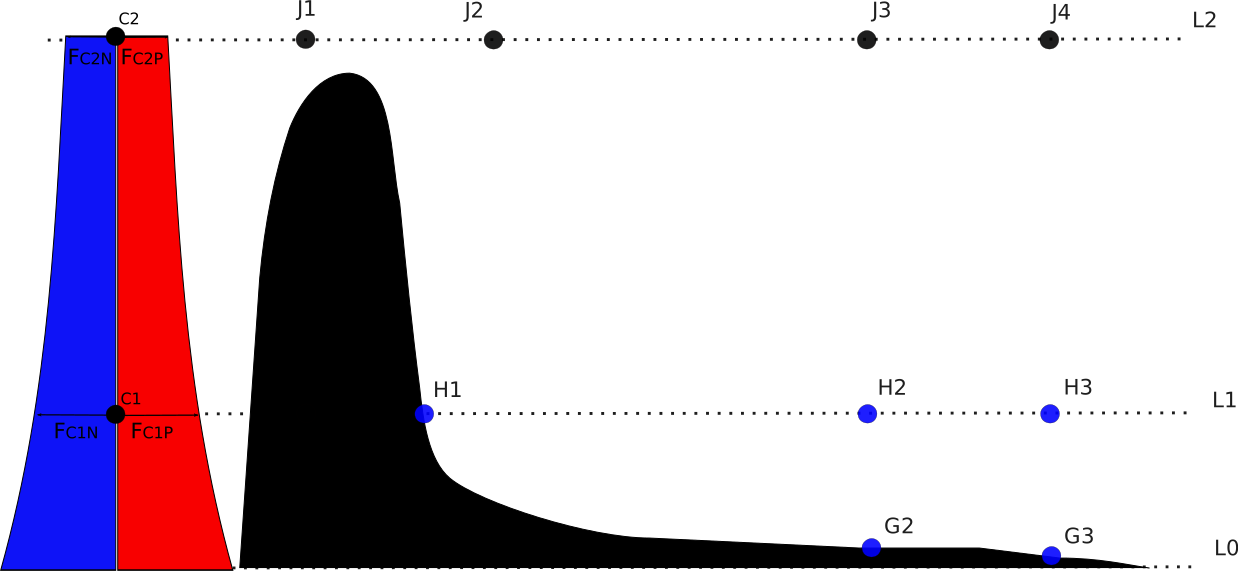
Fig. 2. Z-Continuum looking from the planetary surface
As explained above on this site (ref #), Z-Continuum supports propagation of disturbances of any kind. In the case of a field, it enables the propagation of the electrical field. In that case, the electrical charges of the planet make two types of disturbance that appear as positive and negative fields shown on the left side of Figure 2. Both disturbances have equal magnitude at any given altitude. As a result, the net force of them equals zero and is “supposed to be nothing” in the physics of the 20th century. However, the physical presence of those disturbances is real, despite a zero indication from a measuring instrument that does not directly detect them.
Figure 2 shows a general case of Z-Continuum. L0 is some level taken as zero altitude (usually it coincides with the average level of ocean water). L1 and L2 are two other levels beyond Level 1. In other words, altitude L2 is higher than L1. The condition of the Z-Continuum by disturbance at altitude L1 is shown as two forces, Fc1p and Fc1n (coming from positive and negative disturbance). They are equal in magnitude but opposite in direction. Physical forces resulting from each disturbance are vertical concerning altitude levels.
Suppose now this, Bob uses his car for his travel. Moreover, the road maintains the same absolute altitude throughout the entire route (L1). In that case, the physical condition of the Z-Continuum remains constant for the car during the whole route.
Suppose now that there is another traveler (let’s call him Tom) who makes his travel between the same cities by aircraft. The aircraft starts its journey from point H1 (altitude L1), reaches a higher altitude at point J2, maintains that altitude (L2) to point J3, and then descends to the airport located at point G3. The aircraft changes its absolute altitude significantly during its flight. However, Tom does not feel any changes in Z-Continuum during his travel, either, because Z-Continuum makes interactions at the level of physical particles and becomes unnoticeable to both travelers.
There is one more question here. Is there any physical difference between any points located at the same absolute altitude? There is no such difference according to the figure. In other words,
All points located at the same absolute altitude have no difference in the condition of the Z-Continuum
- Allan Zade