
Z-Theory. The Fundamental Paradigm Shift
Can we make a measuring instrument that confirms light propagation as explained above? Yes, it is possible using modern technological levels and engineering.
That device is capable of conducting the Dynamic Aurora Experiment (DAE). It comprises three atomic clocks, assembled in two mobile units and one static unit. Figure 3 shows the operation of that device schematically.

Figure 3. Dynamic Aurora Experiment (DAE)
According to Einstein's illusions, an observer moving with respect to the luminiferous ether has a constant speed of light propagation in the observer-bound reference frame. Figure 3 shows that, in case Z0. In that case, the observer located at point B emits two light beams in two opposite directions, BA and BC.
According to the same illusion, light reaches equidistant points A and C simultaneously, or takes the same duration to cover equal distances BA and BC. That illusion stems from the Michelson-Morley optical experiment (OMMX) and Einstein's concept of a constant speed of light propagation in the observer-bound reference frame, regardless of its motion relative to the luminiferous ether. In other words, Einstein thinks that the duration of light propagation in two equidistant directions is the same for an observer moving in the luminiferous ether.
In Z-Theory, that “luminiferous ether” becomes Z-Continuum and the absolute reference frame that supports the propagation of any possible disturbance, including EM-disturbance called light. Any motion of an inertial object appears as absolute motion of that object in the Z-Continuum
- Allan Zade
Therefore, the anisotropy of light propagation can be detected only by one-way measurement as explained above. In other words,
Two (or more) light beams cover different distances in one-way directions in the observer-bound reference frame by the exact duration of measurement for an observer that moves with respect to the Z-Continuum (the absolute reference frame).
- Allan Zade
Therefore, the measuring instrument uses two light beams (or any other Form of Electromagnetic Radiation) to make measurements. According to Figure 3, the central unit is located motionlessly at point B. Two other movable units are free to take any position relative to the central unit. All units use previously synchronized atomic (or optical) clocks. Directions of measurements are casual on the Earth's surface.
Experiment begins. The central unit B emits a disturbance in the z-continuum (emits a light pulse) in both directions. All units agree that the duration of that pulse equals M oscillations of their clocks. Therefore, they measure the distance covered by light beams for a duration equal to M oscillations of their clocks. At the beginning of the experiment, all clocks indicate N. The experiment ends as soon as the light beam reaches the other units, A and C.
Suppose now this. Unit A detects the light beam at the indication of its clock equal to N+M+X (X is more than zero). That means this. That unit stays farther away from unit B, which emits a light pulse. Therefore, a light pulse takes X more oscillations of the clock to reach that unit. Thus, to determine the proper distance that the light beam covers in M oscillations, the unit needs to move closer to unit B. Unit C makes similar calculations to determine its location relative to unit B. After that, both units change their location in relation to unit B. The experiment is repeated to verify their location. Using that method, both units occupy some locations at points A and C, where the duration of light propagation from unit B becomes equal to that of both units. That means this: both units detect light beams with the exact duration of propagation from the same source.
According to Einstein’s illusion, the distances covered by light rays in any direction should be equal to each other. However, DAE shows an unequal distance between units at the end of measurements. In some particular case, unit A found the correct position at the point A1 and unit C found its correct position at the point C1 (case Z1). Distances between units (A1-B1 and C1-B1) are unequal to each other. Therefore, this experiment demonstrates that light beams travel unequal distances in different directions over the exact duration of propagation. That completely and effectively disproves Einstein’s illusion about light propagation.
According to experimental data coming from Roland De Witte's experiment, he had a distance of measurement of about 1 km (1000 meters) and detected a deviation of light propagation of about 15 nanoseconds.
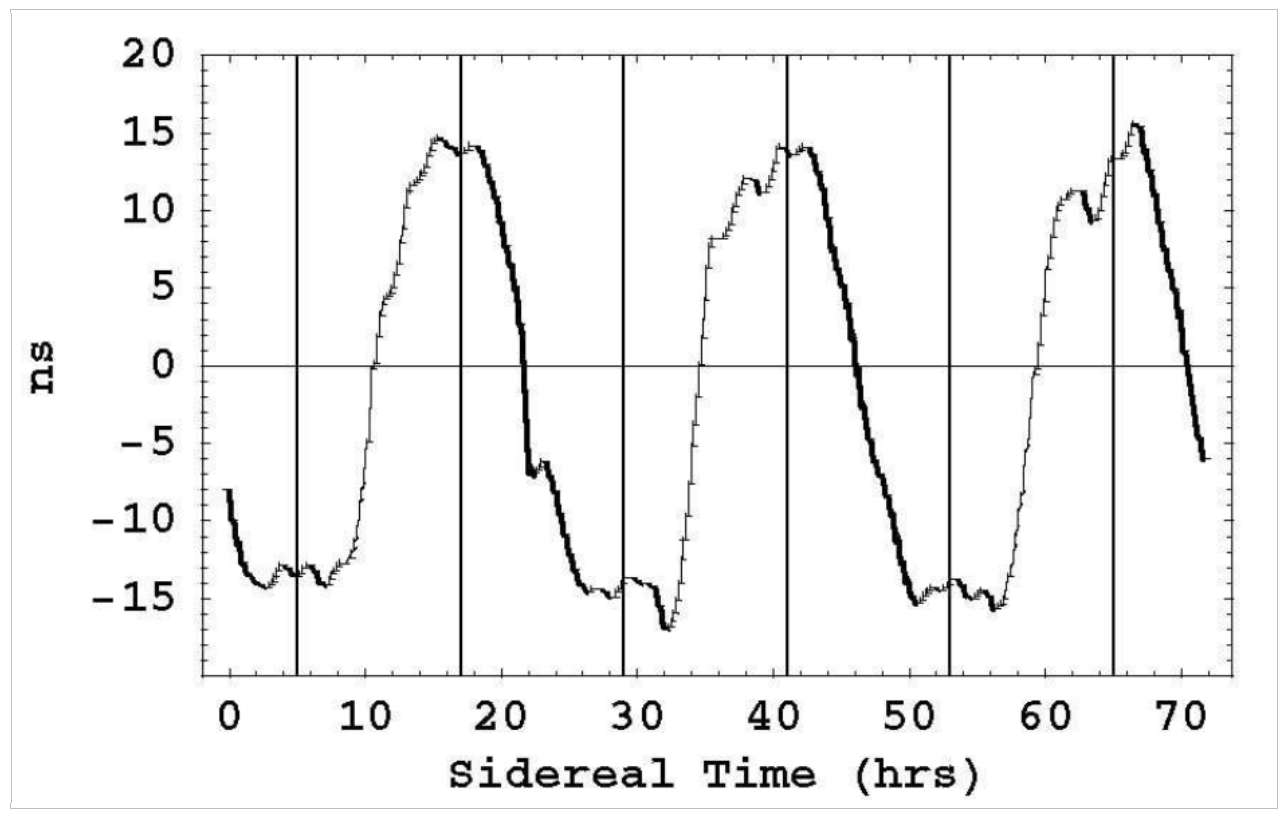
Figure 4. De Witte anisotropy of light propagation by Sidereal time
In the case of DAE, the deviation can be recalculated for distance deviation. Using raw estimation, we have this. 3x10^8 * 15 x10^-9 = 4.5 meters (in case of maximal deviation, CX-C2). In other words, the DAE measurement in the same orientation as the measuring instrument, with a similar distance between measurement points (approximately 1000 meters BA and BC), shows that unit A stays closer to unit B for about 4.5 meters (point A2). At the same time, unit C stays farther away from unit B for the same distance of 4.5 meters (point C2, case Z2). That is the maximal deviation of units regarding their “average location” at equidistant points A and B (case Z0). That is more than enough to be detected by the mechanical location of physical units.
Suppose now this. The units conduct another experiment some time later and continue their operation, making consequent experiments every half hour. In each experiment, units detect their “wrong location” and adjust it to the right one (or equiduration location). As a result, they move in one direction or in the opposite direction over time. Figure 3 shows that the motion exhibits a sinusoidal deviation in other measurement cases (from Z2 to Z4).
However, in all cases, the distance between units A and C remains constant, which supports the idea that only a round-trip experiment shows a constant duration of light propagation (not a one-way experiment).
More than that. The duration of the full circle of the experiment or “time between two consequent equal locations” of units A and C (time between cases Z1 and Z4) coincides with the sidereal revolution of the planet. That confirms the absolute nature of the effect or absolute motion of the Earth regarding the Z-Continuum.
Such an experiment can be conducted in any modern lab. You can perform it yourself. Ask Allan if you have any hesitation in the creation or usage of the measuring instrument. Do you still believe in Einstein’s delusions? Do you still believe anything coming from your University, especially this semester?
What do you say after that experiment? You have to say only one sentence:
DAE, Einstein, DAE!
