
Z-Theory. The Fundamental Paradigm Shift
There is one more aspect here. Suppose now this. You like to detect your motion in the z-continuum or determine your absolute velocity regarding that continuum by light propagation in the same continuum. Albert Abraham Michelson conducted that experiment in 1881. According to the explanation provided above, the experiment operates as follows, as shown in Figure 2.
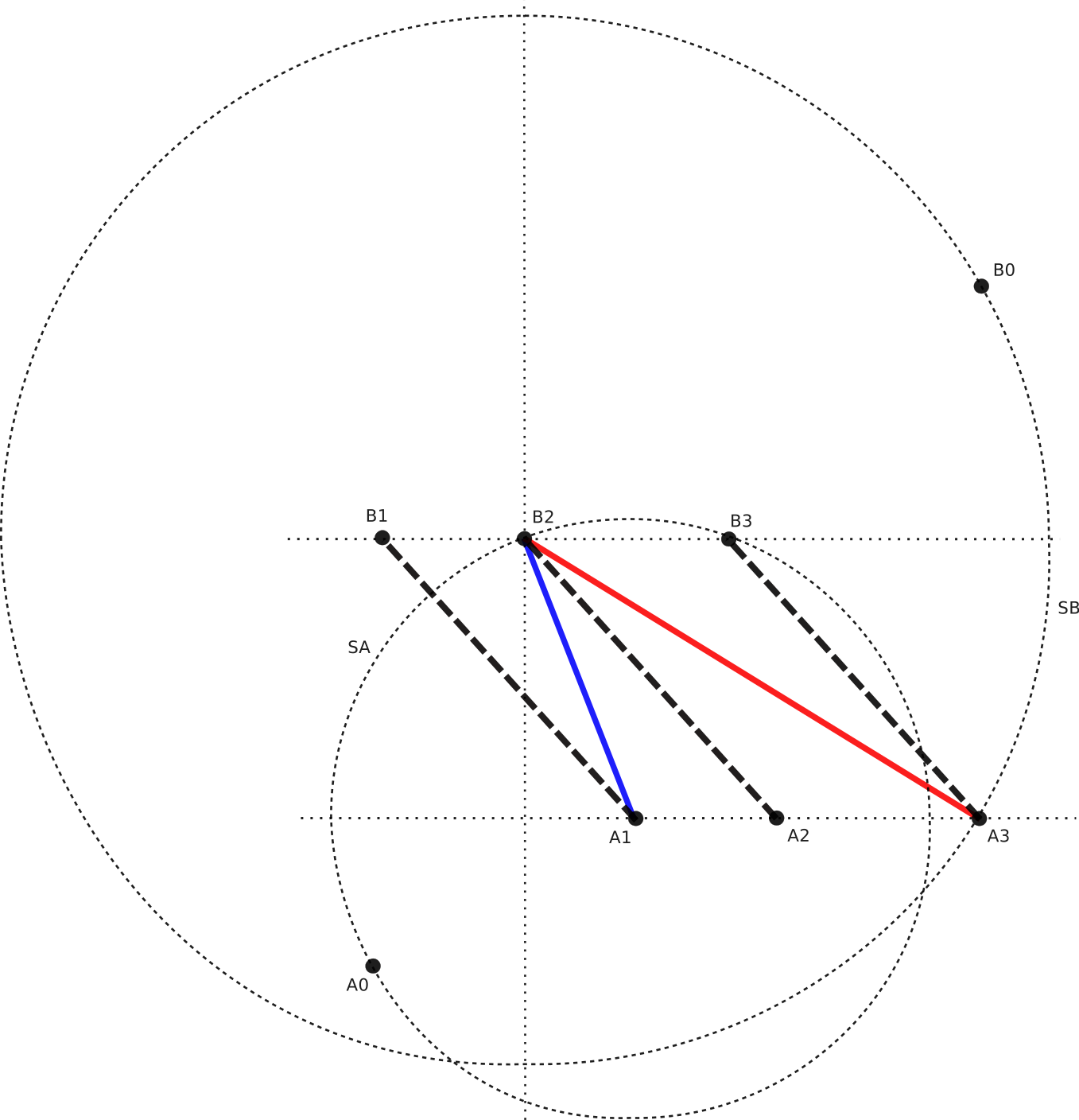
Fig. 2 Michelson light round-trip experiment
The observer uses a rod or a rigid distance between mirrors. The experiment begins at point A1, where the observer starts emitting light in the z-continuum. The other mirror keeps its position at point B1 at that time. A1-B1 is a rigid distance between mirrors in the experiment.
Light emitted from point A1 starts its propagation toward another mirror (mirror B). The propagation of light in the z-continuum has a specific duration. Therefore, light maintains its motion in the continuum, and the observer, with both mirrors, also retains his motion regarding the same continuum. That process finishes as soon as light arrives at point B2, where it meets the mirror B. Therefore, the duration of the motion of light and the duration of the motion of the measuring device are the same.
During that duration D, the measuring device covers the distance of A1-A2 in the z-continuum (equal to B1-B2) because it moves as a solid object. For the same duration, light covers distance A1-B2. That is a different distance and a different direction that does not coincide with the direction of the measuring device (A2-B2) that the observer comprehends as the “true” direction of measurements.
However, light propagation in the observer-bound reference frame (his device) appears to be light propagation along the distance between mirrors A2 and B2. As you can see from that figure, the distance covered by light in the z-continuum (A1-B2) is shorter (in this particular case) than the distance between mirrors of the measuring device (A2-B2). Therefore, the observer detects superluminal speed in that case because, during the experiment, light covers a greater distance in the observer-bound reference frame (A2-B2) than in the z-continuum (A1-B2).
Michelson was unable to detect that effect because it can only be detected in a one-way measurement, and such a measurement requires another device that was inaccessible to Michelson at the time. Therefore, Michelson used a round-trip experiment as the only one accessible to him at that time. It was an engineering problem, rather than a physical, logical, or philosophical one.
In that experiment, light from mirror B bounces back to mirror A (and to the observer). Once again, light and the mirror (A) meet each other at the point A3 regarding the z-continuum. In that case, light covers the distance B2-A3, which does not coincide with the distance and the direction of light propagation in the observer-bound reference frame (B3-A3) or the distance between mirrors.
Once again, light forms a sphere (SB) in its propagation in the z-continuum. The experiment ends as soon as the radius of that sphere matches the distance B2-A3. The duration of the second experiment is greater than that of the first experiment because the measuring instrument has a component that is off by the speed of light from the light source (the direction B2-B3, as defined by the experiment). Therefore, the light beam requires an additional duration to “catch” mirror A. As a result, the distance covered by that light also becomes greater and matches B2-A3.
In that case, the observer falls under the illusion that light propagates along his measuring device again by distance B3-A3. Moreover, B3-A3 is less than B2-A3. Therefore, the observer detects the under-luminal speed of light in that experiment. However, Albert Abraham Michelson was unable to do so because of the lack of his measuring techniques and his device. It was once again an engineering problem with the device and a huge philosophical problem for Michelson, who did not understand the deficiency of his device. He was “blind” in his way of thought, made up of his speculations and “calculations.”
It is time to return to Figure 1 and compare the two figures. Equation 1 shows the general case of propagation of any disturbance in any continuum (including light propagation in the z-continuum). Therefore, it applies to the described experiment. That vector equation can be rewritten for the first stage of the experiment as (A1-A2) + (A2-B2) = (A1-B2). In other words,
The “velocity” of the distorted wave (that includes its direction and magnitude) coincides with the direction and the length of the measuring device in the observer-bound reference frame. The observer comprehends that distorted wave as the true wave, which is wrong.
- Allan Zade
In the second phase of the experiment, the equation 1 transforms to the following form: (B2-B3) + (B3-A3) = (B2-A3)
As you can see now, rotation of the rod (or changing the orientation of the measuring device regarding the direction of its absolute motion) changes the duration of each phase of the experiment. Therefore, in the Michelson case, he determines only the sum of both durations instead of each duration taken separately.