
Z-Theory. Introduction
Part 4. Reduced Interaction Area, Rainbow Effect and Fog Effect
Suppose now this. An aircraft flies at some altitude L2 (see Fig. 3). There is nothing unusual between points R1 and R2 in its flight.
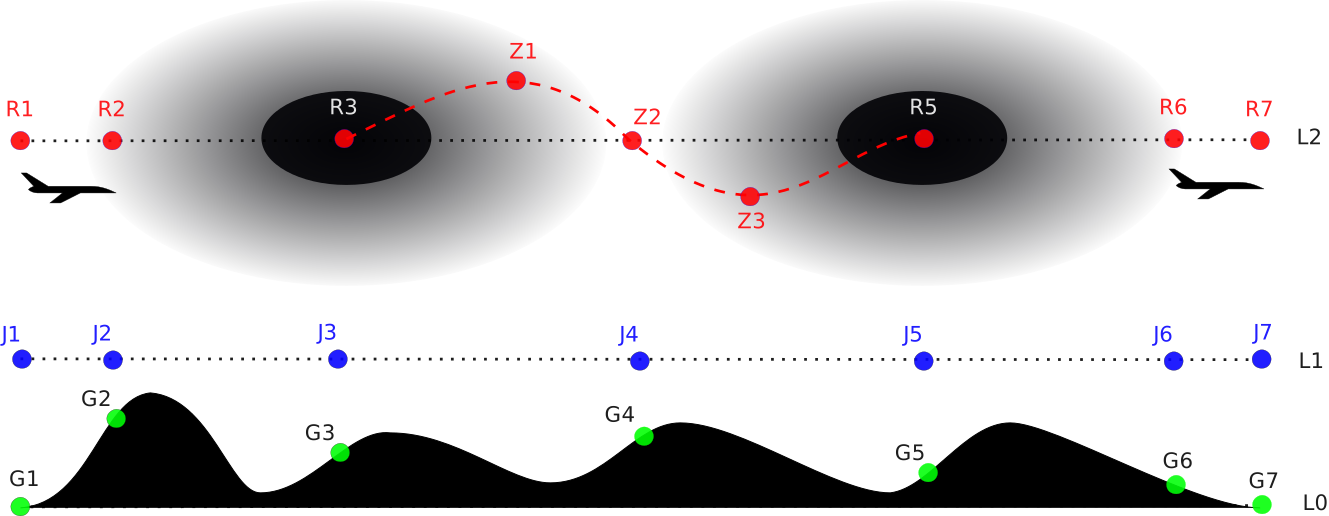
Fig. 3. Z-Gate that appears above the Earth surface
However, as soon as the aircraft reaches point R2, something “strange” appears in view. That happens because the Reduced Interaction Area appears between points R2 and R0. Therefore, the crew on the aircraft experiences a “very unusual” observation between those points.
Exact observation depends on the physical condition of the RIA. For example, suppose RIA starts to reduce interaction with the Low Frequency Band (LFB). In that case, the lowest-frequency phenomena come into view first. The most noticeable phenomenon of this kind is “malfunction of the magnetic compass” because the Earth’s magnetic field is constant or has a zero frequency. A crew commonly describes that phenomenon as “casual spinning of the magnetic needle”. Physically, the magnetic field cannot reach the needle because of RIA. As a result, the magnetic compass becomes useless because it has no interaction with the Earth’s magnetic field. In other words,
The so-called “sudden malfunction of on-board equipment” was caused by the Reduced Interaction Area that the observer reaches by his craft
- Allan Zade
In that case, the crew can send a distress signal about the “malfunction of instruments” because LFB deviation leaves more time for the operation of equipment that uses higher frequencies. Therefore, the onboard radio transceiver continues to operate for some time longer until RIA gradually reduces the higher frequencies as well.
After that, the frequencies of visible light start to be affected by RIA. In that case, the reduction of low-frequency light causes unusual visual phenomena for the crew. The crew sees a “green and blue coloration” of all things around them. That happens because the low-frequency band of the visible spectrum becomes suppressed, and only light waves with higher frequencies (mostly green and violet) reach the crew.
Such phenomena continue and increase in magnitude to the point R0, where RIA blocks all interaction between the aircraft and the other part of the Z-Continuum. In other words, the aircraft reaches the condition of complete isolation at that point. In other words, no disturbance can become able to reach the plane from the outside, and no disturbance can reach the outside part of Z-Continuum from the aircraft.
In other words, the aircraft becomes “completely invisible from that point”. However, that is not the case with the Z-Continuum condition. That is only a consequence. The reason for such a condition is the transformation of the Z-Continuum so that it reaches another ESP. As a result, Z-Continuum forms Z-Gate (or a tunnel) between points R3 and R5.
Point R3 is equal to R5. Those points, as well as all other points inside Z-Gate (Z1, Z2, Z3, etc.), are ESP points that do exist outside of Z-Continuum in its common condition that we call space in the 20th century. Therefore, the aircraft changes its W-trajectory to a Z-trajectory at point R3 and maintains the Z-trajectory until it reaches point R5. Points R3 and R5 become Gaps. R3 becomes In-Gap for the aircraft because it uses that point to reach the Z-Trajectory. R5 becomes Out-Gap because the aircraft uses that point to return from the Z-Trajectory.
As mentioned above, all ESPs appear equal in terms of the level of interaction between an object located within them and the Z-Continuum. Therefore, relocation between any of such points does not change anything for the object (or the aircraft). Therefore,
The Physical condition of the physical object remains intact before, inside and/or after usage of Z-Gate. The object does not need to cover a distance by Z-Trajectory in the common understanding of “space”. It just disappears from In-Gap and “reappears” at the Out-Gap. That physical process becomes Transposition in Z-Theory.
- Allan Zade
In other words, an object disappears from one point of the Z-Continuum. It reappears at another point of the Z-Continuum after Transposition. The duration of transposition becomes negligible regarding the duration that the object needs to cover “space” between Gaps because those Gaps are just the same point of Z-Continuum looking from two different perspectives by an observer that stays outside of Z-Gate (like ground observers G3 and G5).