
Z-Theory. Introduction
Part 3. Z-Gates
Moreover, an object keeps the same level of interaction with Z-Continuum at every point of its trajectory as long as it moves from one Equal Strength Point (ESP) to another one. There is one more observation here. An object covers something called “distance or space” between any two ESP. A ground observer understands that because an object can use any trajectory between the first and the last ESP. Those trajectories include other points with different values of interaction with the Z-Continuum. Therefore, motion by those points changes the level of interaction between the object and Z-Continuum. Unlike that way, motion by a trajectory based on ESP keeps the same level of interaction between the object and Z-Continuum. In other words,
An object that uses a trajectory based on any number of ESP never changes its level of interaction with Z-Continuum. Therefore, relocation of the object by those points between the first and the last point looks equivalent to direct relocation between the first and the last point without the usage of any “middle point of W-Trajectory”.
- Allan Zade
In other words, a category of “trajectory” means nothing for such relocation. Moreover, such an object can “disappear” from the first ESP and reappear at the last ESP. In both cases, its motion between those points looks similar whether or not it has a trajectory.
Can Z-Continuum make such shortcuts that lead directly from one ESP to another ESP? There is one more question here. Z-Continuum supports propagation of EM-radiation (see ref # 1). The physics of the 20th century denies it. It is often assumed that EM-radiation propagates without any medium. However, the latest physical tests disprove that point of view (ref. # 2).
To make that shortcut, Z-Continuum should be “relaxed” to its original form when the magnitude of disturbance caused in it by the Earth (or another celestial body) remains constant between any given couple of ESP. Moreover, transformation of Z-Continuum to such a condition makes some “strange looking phenomena” at the first and the last ESP.
Briefly speaking, the Z-Continuum forms a region around ESP where interaction changes from its usual level (or whole level) to zero level. That is the Reduced Interaction Area (RIA or Area of Reduced Interaction – ARI). A common phenomenon of that area appears as a constant reduction of any disturbance (coming from the outside) from its usual level to zero level. Figure 3 shows that graphically.
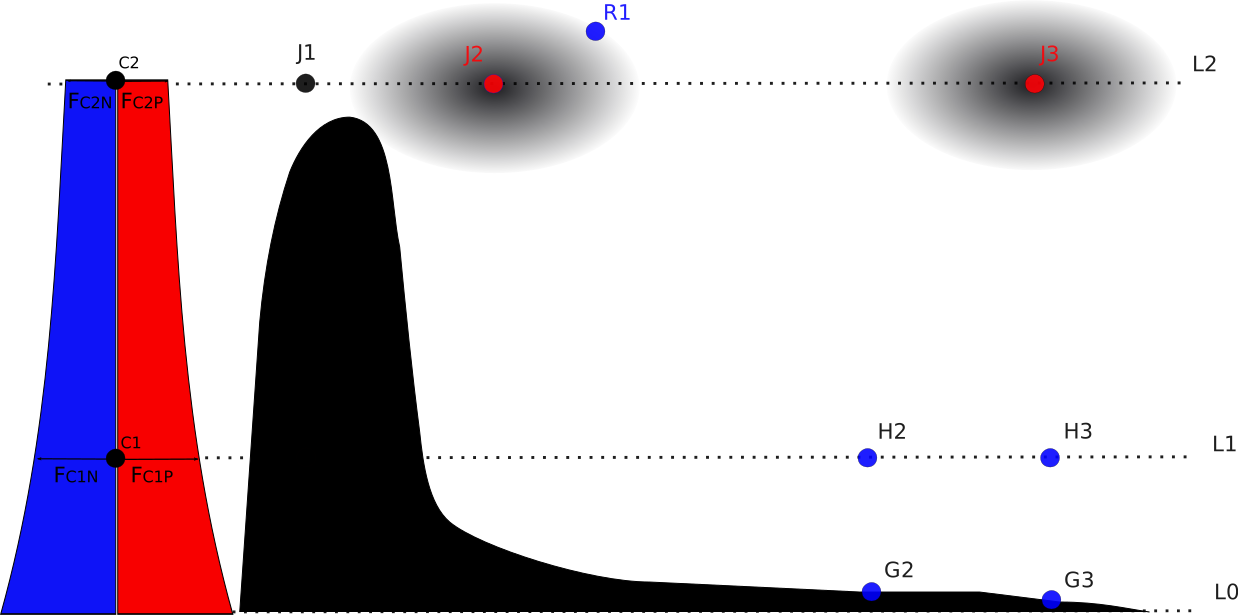
Fig. 3. Gaps of a Z-Gate looking from the planetary surface
The figure shows two ESP J2 and J3 with RIA around them. Suppose now this. An aircraft comes from J1 to J2. Everything looks fine for the aircraft and the crew. However, at some point located between J1 and J2, the interaction level starts to drop slowly. As soon as Z-Continuum is responsible for propagation of any disturbance, all of them begin to fall gradually during further motion of the aircraft.
At some point, the disturbance of the Z-Continuum, known as the Earth's magnetic field, drops to a level where the onboard magnetic compass's needle no longer detects it. From that point on, the measuring instrument becomes useless because its method of operation, based on interaction with the external magnetic field, no longer works. As a result, the crew members become puzzled by a "suddenly broken compass." However, the instrument remains in perfect condition, but the magnetic field cannot reach it because of RIA.
Going further, the crew becomes astonished by some other observations that “the ocean and the sky look strange”. EM-radiation coming from the outside is also affected by RIA. As a result, EM radiation with specific frequency bands reduces its power to a level below its natural level. Therefore, “the sky and the ocean look strange” because of the color shift for all incoming light. That is the Rainbow Effect described in detail in Z-Theory.
Such phenomena increase their level until the aircraft reaches point J2, where the RIA eliminates all incoming disturbances. From that point, ESP J2 has the physical possibility of being connected to another ESP. Suppose it is ESP J3. There is a similar condition of Z-Continuum at point J3. Therefore, the aircraft that reaches point J2 with “relaxed” condition of Z-Continuum uses another way of motion and goes from point J2 to J3 directly without interaction with Z-Continuum at any other points located between J2 and J3 that humankind calls “space”. That way becomes Z-Trajectory in Z-Theory. In other words,
Z-Gate (and Z-Trajectory) connects two ESP outside of the typical appearance of Z-Continuum as “space”
- Allan Zade
As explained above, the "distance" between points J2 and J3 becomes "negligible" regarding the "distance" between them in the "common space". Therefore, the aircraft that passes point J2 reaches point J3 using the Z-Trajectory instead of the W-Trajectory. As a result, it appears that at the point J3, the crew observes all phenomena of RIA in a backward sequence (including "suddenly repaired compass"), and the aircraft appears to be outside of RIA, as if nothing had happened to it. However, the aircraft is located far away from its original location (J2).
Relocation by Z-Gate (Z-Trajectory) beyond “space” becomes Transposition in Z-Theory
- Allan Zade