
Z-Theory. The Fundamental Paradigm Shift
Human beings have been intrigued by light and its properties since the beginning of humankind. Different thinkers from various centuries have offered other explanations of light's nature and its way of propagation.
A few centuries ago, it was suggested that light consists of corpuscles. These tiny particles go through space and appear as visible light. That point of view is a good example of a mechanistic perspective on light. It coincides with the main idea that a physical entity can only be in the form of a mechanical appearance. The human mind rejected at that time another explanation or comprehension of the nature of light.
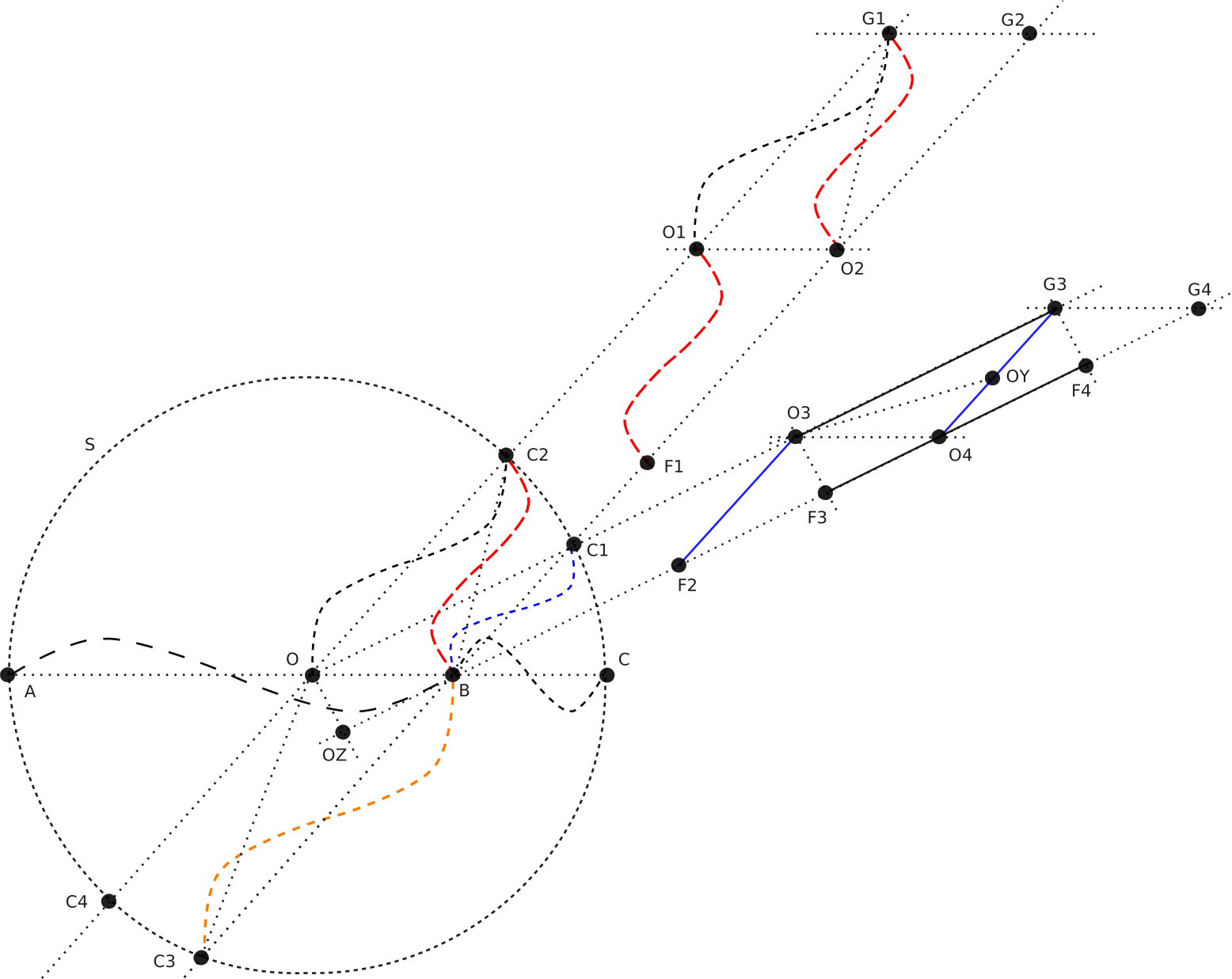
Figure 1. Motion and emission in Z-Continuum
Suppose now this. You belong to another set of thinkers who comprehend reality another way. You do understand the nature of the Z-Continuum as the primary continuum that supports the propagation of any disturbance in the Universe. It exists everywhere. Moreover, any motion of any kind that appears regarding that continuum becomes absolute motion. What happens in that case if you describe the motion of observers and the propagation of a disturbance in that continuum? Figure 1 answers that question. The following elements are depicted in the figure.
The first observer has his initial location at point O. All mentioned locations are absolute. i.e., they belong to themselves. The continuum coincides with the picture plane.
Initially, the first observer maintains a static location in the continuum at point O. He makes some disturbance in the continuum. According to Huygens' principle, the disturbance goes in every direction, forming a perfect sphere in a continuum with the center at point O. Figure 1 shows a cross-section of that sphere as circle S.
Suppose now this. There is another observer located at point O1. He also keeps a motionless location regarding the same continuum. Disturbance made by the first observer goes in every direction, including direction O-O1 that coincides with the direction from the first observer to the second one.
After some duration of propagation, that disturbance reaches the second observer. The observer detects the disturbance as a wave that passes through his location and interacts with his measuring instruments. Those instruments tell the observer this. The duration of interaction between a measuring instrument and the wave has some exact value. During that duration, the wave makes a full circle of interaction with the measuring instruments.
The observer understands it as a wave that passes through his point of location from the point of origin (O) and has a wavelength equal to O1-G1. The second observer exchanges information with the first one and agrees that the duration of interaction with the wave at his point of location coincides with the duration of wave emission at the point of location of the first observer. Both observers agree that there is no difference in their emission and detection of the wave.
Suppose now this. Both observers start moving in the same direction with respect to a given continuum at the same speed. At that speed, the first observer covers some distance OB regarding the continuum. The second observer covers the distance from O1 to O2. Distances OB and O1-O2 are equal to each other because both observers have an equal speed regarding the continuum (or observer-to-continuum speed of motion).
They start a similar experiment again. The first observer emits a wave, and the second observer detects that emission. The first observer covers the distance OB in the duration of one full wave's emission. He starts the emission of that wave at the point O, likewise as in the first experiment. However, the emission of a whole wave has a specific duration. By that duration, the observer finishes emitting the wave at point B instead of O.
Therefore, the wave emitted in that direction becomes distorted by the motion of the first observer and appears as some wave B-C2 that travels in the same direction as the wave in the first experiment (O-C2). After a specific duration of propagation, this wave reaches the second observer and starts interacting with his measuring equipment.
That wave starts its interaction with the observer (and its equipment) at point O1. The observer goes further in the continuum as well as the wave. As a result, the second observer covers the distance O1-O2 by the duration of emission of a whole wave. At the same time, the wave distorted by the motion of the first observer reaches the same point (O2). As a result, the second observer detects the exact duration of interaction with that wave. He compares the duration of interaction with one full wave in both cases (motion and motionless location). He falls under the delusion that both experiments are identical in nature because the detected duration of interaction between a given wave and the observer remains constant.
The first observer also falls under a similar delusion because he uses the same duration to make a wave in both cases. Therefore, both observers have a delusion that their motion relative to the continuum does not affect the experiment.
That delusion stems from the simplest measurement method, which involves only determining the duration of interaction with a wave and nothing more. As a result, neither observer detects any difference in measurements. Therefore,
The easiest way of measurement is not the best one
- Allan Zade